Components Guide
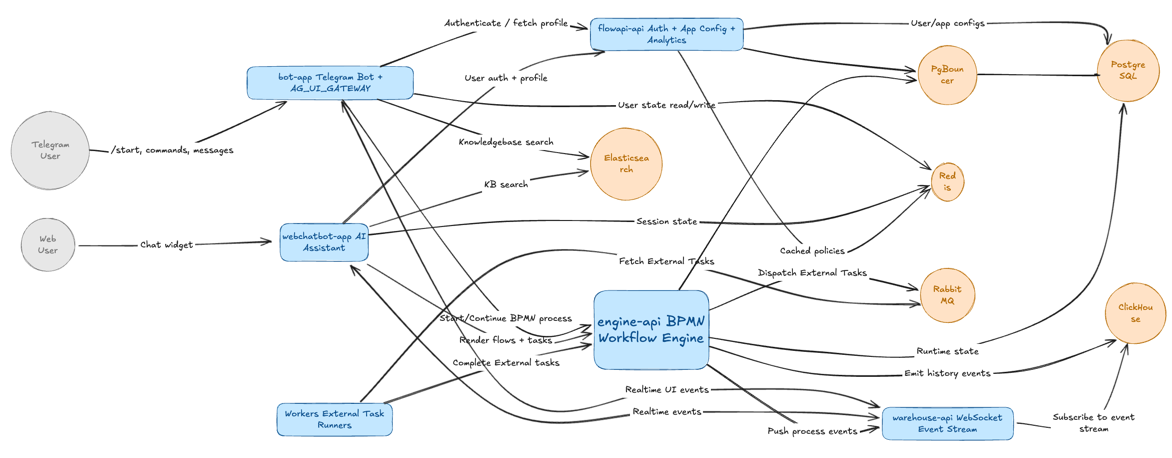
Stateless Components
bot-app
Type: Kubernetes Deployment (stateless, horizontally scalable)
Purpose: Telegram bot with integrated AG-UI Gateway
Technology Stack: - Python (Telegram Bot API) - AG-UI Gateway (SSE API, forms, tools) - Redis client - Elasticsearch client - HTTP clients (FlowAPI, EngineAPI, warehouse-api)
Key Features: - Telegram message handling and routing - Onboarding flows - Knowledge base search (Elasticsearch RAG) - BPMN form rendering (from Camunda engine) - Inline keyboards, reply buttons, suggestions - Wallet integration (Solana) - Quest progress tracking
Connections: - Redis — User state and session management - FlowAPI — Authentication and app configuration - EngineAPI — BPMN workflow orchestration - Elasticsearch — Knowledge base RAG queries - warehouse-api — Real-time event notifications (WebSocket)
Configuration:
env:
  - TELEGRAM_BOT_TOKEN
  - REDIS_URL
  - FLOWAPI_URL
  - ENGINEAPI_URL
  - ELASTICSEARCH_URL
  - WAREHOUSE_API_URL
  - CAMUNDA_ENABLED  # true/false
Scaling: Horizontally scalable via HPA (Horizontal Pod Autoscaler)
webchatbot-app
Type: Kubernetes Deployment (stateless, horizontally scalable)
Purpose: Intercom-style AI chat widget for web
Technology Stack: - Next.js (React) - CopilotKit (AG-UI Protocol) - AG-UI Gateway client (SSE API) - Redis client
Key Features: - Embeddable chat interface (AG-UI compatible) - Real-time responses via AG-UI Gateway - Forms and tool execution - Shared context with Telegram bot
Connections: - AG-UI Gateway (within bot-app) — Unified backend - Redis — Session management
Configuration:
env:
  - AG_UI_GATEWAY_URL
  - REDIS_URL
Scaling: Horizontally scalable via HPA
engine-api
Type: Kubernetes Deployment (stateless, horizontally scalable)
Purpose: BPMN workflow engine (Camunda 7)
Technology Stack: - Java (Camunda 7) - PostgreSQL client (via PgBouncer) - ClickHouse client - RabbitMQ client
Key Features: - Executes BPMN workflows - Visual workflows (BPMN diagrams or text/YAML) - Forms engine (generated or Camunda forms) - Task lists (user, LLM, automated actions) - External tasks (dispatched via RabbitMQ) - Event-driven triggers
Data Storage: - PostgreSQL (via PgBouncer) — Runtime state and process definitions - ClickHouse — Historical events and analytics
API Endpoints:
- POST /process-definition/{id}/start — Start process instance
- POST /task/{id}/complete — Complete user task
- GET /task — Query task list
- GET /process-definition — Get process definitions
- POST /deployment/create — Deploy workflow
Configuration:
env:
  - POSTGRES_URL  # via PgBouncer
  - CLICKHOUSE_URL
  - RABBITMQ_URL
Scaling: Horizontally scalable via HPA
flowapi-api
Type: Kubernetes Deployment (stateless, horizontally scalable)
Purpose: Authentication, app configuration, and analytics API
Technology Stack: - Node.js / Python - PostgreSQL client (via PgBouncer) - Redis client - JWT library
Key Features: - Auth layer (JWT-based) - Application configurations - Analytics API - User management
Data Storage: - PostgreSQL (via PgBouncer) — Users, apps, configurations - Redis — Cache and session data
API Endpoints:
- POST /auth/login — User authentication
- GET /apps/{id}/config — Get app configuration
- GET /analytics/engagement — Engagement metrics
- GET /users/{id} — User profile
Configuration:
env:
  - POSTGRES_URL  # via PgBouncer
  - REDIS_URL
  - JWT_SECRET
Scaling: Horizontally scalable via HPA
warehouse-api
Type: Kubernetes Deployment (stateless, horizontally scalable)
Purpose: Event warehouse and real-time notifications
Technology Stack: - Node.js / Python - WebSocket server - ClickHouse client
Features: - WebSocket interface for real-time events - Pushes updates to clients from engine events - Historical event storage (ClickHouse) - Analytics queries (event aggregation, dashboards)
WebSocket Events:
- task.created — New task available
- task.completed — Task completed
- process.started — Process instance started
- process.completed — Process instance completed
Configuration:
env:
  - CLICKHOUSE_URL
  - ENGINE_API_URL
Scaling: Horizontally scalable via HPA
Workers
Type: Kubernetes Deployment (stateless, horizontally scalable)
Purpose: Async workload processing
Technology Stack: - Python / Node.js - RabbitMQ client - Various tool integrations (LLM, image processing, etc.)
Features: - External task workers (RabbitMQ consumers) - Off-chain computation - LLM tasks - Long-running async actions - Workflow integrations
Worker Types: - LLM Workers — Process LLM requests - Image Workers — Image processing, OCR, generation - Whisper Workers — Voice transcription - On-chain Workers — Solana blockchain lookups - Custom Workers — Project-specific integrations
Configuration:
env:
  - RABBITMQ_URL
  - WORKER_TYPE  # llm, image, whisper, onchain, custom
  - TOOL_CONFIGS
Scaling: Horizontally scalable via HPA
Stateful Components
PostgreSQL
Type: Kubernetes StatefulSet
Purpose: Primary database for runtime state and configurations
Used By:
- engine-api → BPMN runtime state and process definitions
- flowapi-api → Users, apps, auth, configurations
Access: Exclusively via PgBouncer for connection pooling
Scaling: - Vertical scaling (CPU, memory) - HA setup (primary + replicas)
Backup: pgBackRest
Configuration:
resources:
  requests:
    cpu: 2
    memory: 4Gi
  limits:
    cpu: 4
    memory: 8Gi
ClickHouse
Type: Kubernetes StatefulSet
Purpose: Event bus and analytics storage
Stores: - Engine events (from Camunda) - FlowAPI analytics - Engagement metrics - Quest/event logs
Scaling: Shards + replicas
Backup: ClickHouse backups
Configuration:
replicas: 3
shards: 2
Redis
Type: Kubernetes StatefulSet
Purpose: Cache and state machine
Used By:
- bot-app — User state and session management
- flowapi-api — Cache for app configs and user data
- webchatbot-app — Session management
Scaling: - Redis Sentinel (HA) - Redis Cluster (horizontal scaling)
Backup: Optional snapshots (ephemeral data)
Configuration:
mode: sentinel  # or cluster
replicas: 3
RabbitMQ
Type: Kubernetes StatefulSet
Purpose: Message queue for async processing
Handles: - External tasks (from Camunda engine) - LLM jobs - Long-running async actions - Workflow integrations
Scaling: Quorum queues
Backup: Queue definitions backup
Configuration:
queue_type: quorum
replicas: 3
Elasticsearch
Type: Kubernetes StatefulSet
Purpose: Knowledge base search (Dynamic RAG)
Used By:
- bot-app — Knowledge base search for Telegram bot
- AG-UI Gateway (within bot-app) — Knowledge base search for webchatbot
Scaling: Multi-node cluster
Backup: ES snapshots
Configuration:
replicas: 3
storage: 100Gi
Component Interactions
Request Flow Example
- User sends message to Telegram bot
-
bot-appreceives via Telegram Bot API -
bot-app checks Redis for user state
-
Retrieves session and context
-
bot-app authenticates via FlowAPI
-
JWT token validation
-
bot-app queries Elasticsearch for RAG
-
Knowledge base search
-
bot-app starts workflow via EngineAPI
-
BPMN process instance
-
EngineAPI writes to PostgreSQL
-
Runtime state stored
-
EngineAPI emits events to ClickHouse
-
Analytics events logged
-
EngineAPI dispatches external task to RabbitMQ
-
Async processing
-
Worker consumes task from RabbitMQ
-
Processes async action
-
warehouse-api pushes WebSocket event
- Real-time notification to bot/webchatbot
Configuration Management
Environment Variables
Each component uses environment variables for configuration:
- Database URLs — PostgreSQL, ClickHouse, Redis, Elasticsearch
- Service URLs — FlowAPI, EngineAPI, warehouse-api
- Secrets — JWT secrets, API keys, tokens
- Feature Flags —
CAMUNDA_ENABLED,RAG_ENABLED, etc.
Secrets Management
- Vault — Enterprise secret management
- Kubernetes Secrets — Standard K8s secret storage
- Launcher Wizard — Generates and injects secrets
Monitoring & Observability
Health Checks
- Liveness probes — Component health
- Readiness probes — Service availability
- Startup probes — Initialization status
Metrics
- Prometheus — Metrics collection
- Grafana — Dashboards and visualization
Logging
- Centralized logging — All components log to centralized system
- Structured logs — JSON format for parsing
Next Steps
- Read the Architecture Overview for system-level understanding
- Check the Requirements for deployment requirements
- Learn about the Launcher Wizard for automated deployment